6. PDEV auxiliary granules
This document describes how PDEV objects use auxiliary granules, how those granules relate to PDEV streams, and how the PDEV stream and RMI_PDEV_COMMUNICATE interact with them. The intent is to provide a high-level view of the data layout and access patterns.
6.1. Overview
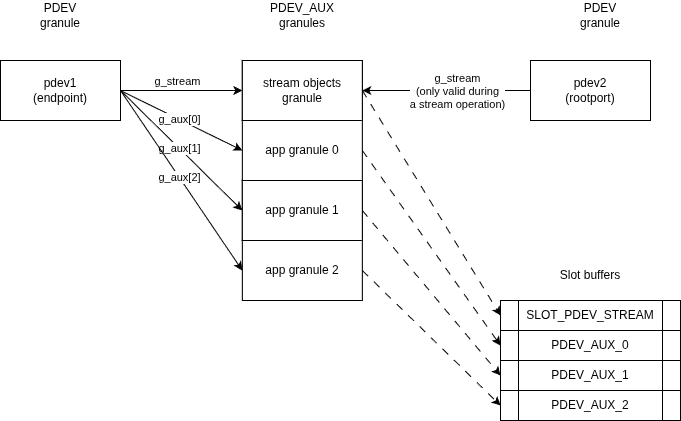
Only endpoint PDEV objects own auxiliary granules that are donated by the host during PDEV creation. In the current implementation a PDEV stream always connects a rootport and an endpoint PDEV, so stream information is stored in the endpoint (pdev1) stream objects granule. Auxiliary granules are split into:
A single “stream objects” granule used to store PDEV stream state.
The remaining “app” auxiliary granules used as per-instance memory for the device-assignment app instance, as described in EL0 apps in RMM.
PDEV auxiliary granules are tracked in the PDEV structure and are mapped into
slot buffers as needed. The stream objects granule is mapped through
SLOT_PDEV_STREAM. The app auxiliary granules are mapped as a contiguous
range starting at SLOT_PDEV_APP_AUX0.
6.2. Granule layout and role
During PDEV creation, the auxiliary granules are:
Transitioned to the PDEV auxiliary granule state.
Zeroed and then recorded in the PDEV structure.
The first auxiliary granule (index 0) is reserved for stream objects and holds an array of per-stream entries.
The remaining auxiliary granules are passed to the device-assignment EL0 app.
6.3. PDEV stream interactions
The PDEV stream SMCs operate on stream objects stored in the stream objects granule. These ABIs receive both pdevs as parameters, so the implementation can access the granule holding the streams.
At the start of a stream operation, the address of the stream objects granule is saved in the rootport granule so the rootport can access the stream state even though the granule was allocated for the endpoint PDEV.
The stream objects granule is always locked before being mapped in all the ABIs because it is accessed from other PDEVs. The app auxiliary granules are not locked because they are only used by their owner PDEV.
6.4. PDEV communication workflow
smc_pdev_communicate uses the PDEV auxiliary granules to support
device-assignment app execution.
For stream-related communication, the workflow is driven by the fields in
pd->op:
pd->op.curridentifies the operation in progress, such as connect, disconnect, key refresh, or stream completion.pd->op.op_stream_typeidentifies which per-stream entry in the stream objects granule belongs to that operation.pd->op.stream_op_stateholds the step of the stream handshake whilesmc_pdev_communicateis executing.
The stream-management SMCs initialize pd->op.curr and
pd->op.op_stream_type when they start a stream operation. When
smc_pdev_communicate runs for one of those operations, it uses
pd->op.op_stream_type to lock and map the matching stream object from the
auxiliary granule, copies stream->op_state into
pd->op.stream_op_state, and then calls the common communication path.
That communication path advances pd->op.stream_op_state through the
rootport/endpoint handshake (for example START, RP_READY,
EP_READY, and RP_CONNECTED) while pd->op.curr remains the current
high-level operation. When smc_pdev_communicate returns, the updated
pd->op.stream_op_state is written back to stream->op_state before the
stream object is unmapped and unlocked.